Showing posts with label Theophila Paulina GOETTLING. Show all posts

Sunday, 18 September 2016

The Jones Family Part VII: Explorers and Troubadours.


In my last post, I talked about the construction of the railway to Kapunda.

The public in the early 1860s were gripped with explorer mania. People lapped up the stories of exploration and adventure around the world. Explorers were celebrated as heroes, and they were latched onto by Australians searching for a national identity.

Kapunda being the last stop on the new railway became a good departure point for exploration expeditions. My ancestors Thomas Rowlands and Theophila Jones were running their hotel the Sir John Franklin in Kapunda and these events influenced the direction their lives would take.

The South Australian Relief Expedition


The Victorian Exploring Expedition, better known now as the Burke and Wills Expedition, set off from Melbourne for the interior of Australia in August of 1860.[i] After six months people began to be concerned for the fate of the explorers. Four different Relief Expeditions were assembled to search for the men. The Relief Expedition put together by the South Australian Government was headed by John McKinlay. They hoped to beat the Victorian Relief expedition headed by Alfred William Howitt to Coopers Creek.

John McKinlay
State Library of South Australia [B 5955]


John McKinlay’s relief Expedition assembled at The Sir John Franklin Hotel in Kapunda on Friday the 16th of August 1861. McKinlay, Mr. William Oswald Hodgkinson, and four camels arrived in Kapunda via the new railway and met with the rest of their party and supplies.[ii] The camels along with the horses for the expedition were kept in the yards of the Sir John Franklin Hotel. Camels were a rarity in Australia at the time, so it caused quite a lot of excitement. The camels in the McKinlay expedition were from the same group of camels that were used for the Burke and Wills expedition. The Victorian Expedition had selected a number of camels and left four camels behind at Royal Park in Victoria (two were pregnant cows). Along the way three camels strayed from the Burke party, two were re-captured in South Australia. The South Australian Relief Expedition had the two re-captured camels and two sent from Royal Park in Victoria.
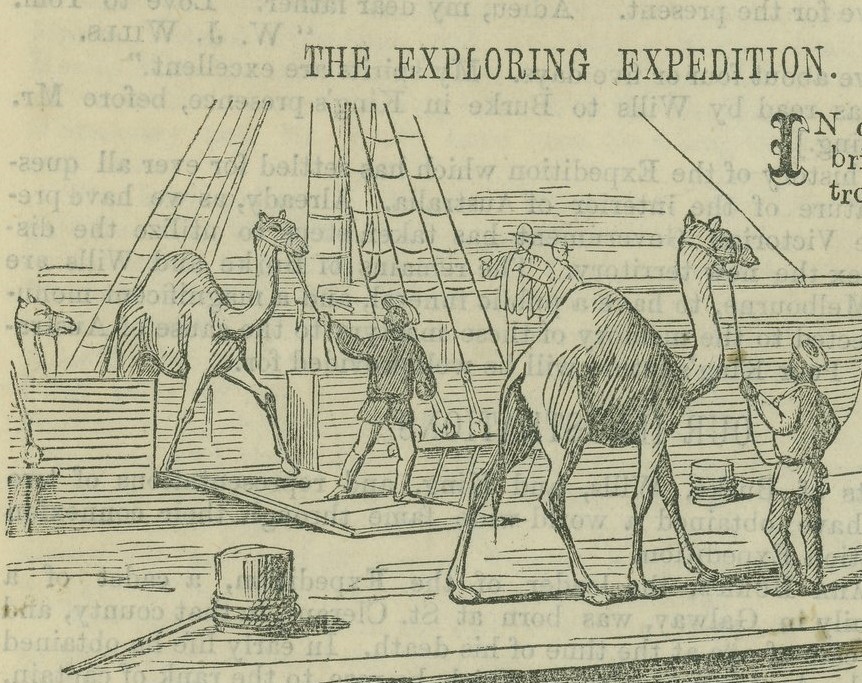
Burke and Wills Expedition Camels 1861
State Library of Victoria H5117
The party was due to depart on Saturday the 17th August 1861. It was market day so Kapunda was full of people, and some had even travelled up on the train from Adelaide. Everyone wanted to witness the excitement and wave off the explorers. Mr. Hodgkinson amazed the crowd with the obedience of the camels, how they followed his verbal commands. I wonder how excited my Great Great Grandmother Elizabeth Jones at 10 years old would have been, right bang in the middle of this great spectacle. I wonder if she had a chance to get close to one of the “ships of the desert”. My Great Great Great Grandmother Theophila Jones had a new-born baby to take care of in this busy time. Horace Foley Jones had been born exactly two weeks before.


It was quite poignant that the Burke and Wills relief expedition was departing from a hotel named after a great explorer and former governor of Tasmania. Sir John Franklin and ships the HMAS Erebus and Terror had been missing in the arctic for about 15 years. Many expeditions had been sent to discover their fate. In 1854 Inuit people told a search party the grisly fate of the ice-bound crew. All 129 crew died when icebound and starving. The crew included the cousin of William John Wills, Lieutenant Henry Thomas Dundas le Vesconte.[xvii] Sir John Franklin’s death was only confirmed in 1859 when a handwritten note beneath a cairn of stones was discovered.

At the time of the McKinlay Party departure from Kapunda, the cart that was to carry the bulk of their heavier supplies for the first section of their journey broke an axel when it hit a small rut. McKinlay remained overnight with the cart and four horses whilst it was quickly repaired. The rest of the party set off for a nearby property 9 miles (about 14 Km) North of Kapunda to set up camp for the night. They comprised of around 8 men, four camels and 18 horses. The spectators crowded the streets and yards of the Sir John Franklin hotel, giving the explorers a hearty three cheers and wishing them “God Speed”.


The Burial of Burke. Artist: Strutt, William 1825-1915.State Library of Victoria, Image H13087

McKinlay and party found the grave of Charley Gray near Cooper's creek, and soon after learned that Howitt had already arrived at Cooper’s Creek and had discovered and buried the remains of Burke and Wills. Howitt had left to return with the survivor John King, who had been cared for by the Yandruwandha people. The McKinlay party then continued their exploration of the interior, with the hope of discovering more grazing land. They arrived back in Adelaide late in 1862.


John McDouall Stuart’s Sixth Exploration Party


John McDouall Stuart 1865
State Library of South  Australia [B 500]


On the 7 Dec 1861 the explorer John McDouall Stuart with Frederick John Waterhouse (Naturalist) passed through Kapunda on their way to meet up with the rest of their party at Moolooroo for Stuart’s Sixth Expedition to the interior. Stuart had separated from the rest of the party when he was injured by a rearing horse not long after departure. He was knocked unconscious and his hand was badly trampled. When well enough to travel, five weeks later, he passed through Kapunda. The residents of Kapunda cheered the men on their way.[iii]

This exploration party eventually traversed the continent from North to South, providing a route for the overland telegraph.


The Long Burial March of Burke and Wills


On Wednesday 10 of December 1862 the exhumed remains of Burke and Wills were brought through the town of Kapunda, ready to be sent via train to Adelaide then on to Melbourne for re-burial.[iv] Flags were flying half-mast at the Sir John Franklin Hotel and the church bells tolled. The Kapunda Rifles marched ahead of Alfred William Howitt’s party and people gathered in the streets to pay their respects. The remains of Burke and Wills arrived on camel-back, in a box draped with a Union Jack flag.[v] There is an unconfirmed tale that the box of remains was placed on the main bar of the Sir John Franklin Hotel for people to view and pay their respects.

There are reports though of the remains being viewed at Gawler, so it is possible that they were also viewed at Kapunda:

"The party present then inspected the box containing the remains of the gallant and unfortunate explorers, which were deposited in a moderately sized chest, covered with black cloth, and divided into compartments, one containing the remains of Burke, and the other the headless remains of Wills. It was surprising to notice in how small a compass the relics were contained. In conversation with Messrs, Murray and Howitt, I learned that the head of Wills had not been found, owing, it is supposed, to the wild dogs having carried it into the polygonum scrub, where all attempts to discover it failed. The union-jack interred with the bodies of the brave explorers formed part of the contents of the chest. The remains, accompanied by Messrs. Murray and Howitt and Mr. Sheriff Boothby—a schoolfellow of the latter gentleman—proceeded to Adelaide by the 1.15 train."[vi]

From Adelaide, Howitt continued on by steamer to Melbourne. The idea of publicly displaying remains sounds very odd but was not unusual for the times. The remains were also put on display when they reached Melbourne and drew huge crowds.

The Burke and Wills Funeral Procession Melbourne.
State Library of Victoria IMP24/01/63/8-9  


See the Conquering Hero Comes


17 Dec 1862, (exactly a week after the remains of Burke and Wills passed through town) John McKinlay caught the train from Adelaide to meet John McDouall Stuart at Kapunda who was making his way home from his successful sixth expedition. Kapunda’s Mine Volunteer Band assembled on the balcony of the Sir John Franklin hotel playing “See the conquering hero comes” to welcome the famous explorers.[vii][viii] Stuart was very unwell, he had been carried by litter between two horses for 900 km of his journey. He had begun to recover enough to ride though by the time they reached Mount Margaret.[ix] Stuart was suffering from scurvy, malnutrition and was nearly blind from trachoma.

John McDouall Stuart being carried ny "ambulance'
during his sixth expedition. Sketched by Stephen King Jr. 1862

State Library of South Australia [B 59536]


The explorers were greeted by a celebration at the Sir John Franklin hotel.

“Mr. McKinlay was the first to shake hands with his brother hero, and such was the crowd of persons anxious to catch a glimpse of the great little explorer that he stood a fair chance of being suffocated. Having adjourned to the Sir John Franklin, the congratulatory address was read and presented by Mr. Browne, S.M. Mr. Stuart returned thanks for the kind and hearty reception, and said his expedition had been most successful, and its beneficial results would soon be seen in all the colonies. The party had then to hurry to the Railway Station, accompanied by a variety of vehicles, and Mr. Stuart, Mr. Auld, and Mr. McKinlay went down in the train.”[x]

Stuart never fully recovered his health after his last expedition.


Douay and Poussard


Horace Remi Poussard and Réné Douay were talented French violinists. They arrived in Australia in 1861 and during 1862 they had a gruelling tour of South Australia. They performed most nights and travelled town to town. They had regular singers and other musicians as part of their show.

Douay and Poussard performed a wide range of music but their extraordinarily popular piece “Dead Heroes” written to celebrate the lives and achievements of Burke and Wills, struck a chord with the South Australian crowd. It was poetry set to a musical composition that was a complicated medley of different popular tunes, arranged to tell the story of the Burke and Wills Expedition. It was a piece that evolved over time as it was performed over many months.[xi]

In 1862 Douay and Poussard performed a number of times in Kapunda to great applause and hearty calls of encore. With such recent and frequent contact with exploration parties, the locals of Kapunda were a primed audience for their piece the “Dead Heroes”. They came to Kapunda in July, October and in November of 1862.[xii]

In August 1862 Douay and Poussard failed to turn up at one of their booked performances in Kadina, after flatly refusing to travel. This caused a huge dispute with their manager Robert Sparrow Smythe. It led to a break up between the duo and their manager and also resulted in legal action.[xiii]


1862 'Advertising', South Australian Register (Adelaide, SA : 1839 - 1900), 3 September, p. 1. ,
viewed 13 Sep 2016, 
http://nla.gov.au/nla.news-article50175741


Poussard and Douay performed for McKinlay on his return from his expedition in November 1862. Douay performed a harmonium solo titled “Welcome in honour of McKinlay and Party” and a poem titled “Homage to McKinlay” was also performed. [xi]

The Return of Stuart to Adelaide 1863
State Library of South Australia [B 9382]


In Adelaide there was great celebration on the return of Stuart, which included a large street parade. There was a performance by Poussard and Douay on the 22nd January 1863 at the Adelaide Assembly Rooms in honour of Stuart and McKinlay, who attended the show. It was the last time they performed “Dead Heroes” in South Australia.[xiv]


Hard Times and a New Hope


Despite the promise of booming business with the arrival of the railway, business at the Sir John Franklin Hotel was suffering. Costs had gone up, but business had gone down. After the railway was constructed, a road connecting the train station to the rest of town was built. The road controversially did not run directly to the main street where the Sir John Franklin was positioned. As a result, three new hotels were built along this new road and managed to capture some of the rail traveller business. Also,“Crase’s Room” was built, which became a rival function venue. On top of all this, the number of men working at the mine had reduced considerably, and those that remained were earning less. In May 1862 Thomas Rowlands Jones petitioned the court reduce the cost of his lease. [xv] The initial lease was taken out at £350 per year and he hoped to have it reduced to £250. His request was granted and the rent was lowered.

It is probable that even with the cost reduced lease, the Sir John Franklin Hotel was not as profitable as Thomas had once hoped. Thomas began to look for a new venture.

After their breakup with Robert Sparrow Smythe, Poussard and Douay were in need of a new manager, and Thomas Rowlands Jones stepped into the job.


"Mr. T. R. Jones having entered into an engagement with Messrs. Poussard and Douay, will leave the Sir John Franklin Hotel, which he has so satisfactorily conducted, in the course of the month."[xvi]

I think that his love of music and his business experience would have made him a great choice for the position. I also wonder if his ability to speak German could have been an advantage in communicating with the Frenchmen.


1863 'Advertising', South Australian Register (Adelaide, SA : 1839 - 1900), 20 January, p. 1. ,
viewed 18 Sep 2016, http://nla.gov.au/nla.news-article50164844


My Next Post will be about Thomas Rowlands Jones on tour with Poussard and Douay and his return home to Adelaide.

I really recommend reading about Sir John Franklin. He really was a man of action and lived an extraordinary life.

Canadian Geographic has a good timeline here: http://maps.canadiangeographic.ca/franklin-search-timeline/franklin-search-timeline.asp

The Franklin expedition is in the recent news here: https://www.theguardian.com/world/2016/sep/12/hms-terror-wreck-found-arctic-nearly-170-years-northwest-passage-attempt


[i] http://burkeandwills.slv.vic.gov.au/ 

[ii] 1861 'THE BURKE RELIEF PARTY.', The South Australian Advertiser (Adelaide, SA : 1858 - 1889), 19 August, p. 3. , viewed 15 Jul 2016, http://nla.gov.au/nla.news-article876609

[iii] 1861 'KAPUNDA.', Adelaide Observer (SA : 1843 - 1904), 14 December, p. 7. , viewed 10 Sep 2016, http://nla.gov.au/nla.news-article158184509

[iv] 1862 'KAPUNDA.', The Sydney Morning Herald (NSW : 1842 - 1954), 11 December, p. 4. , viewed 10 Sep 2016, http://nla.gov.au/nla.news-article13070760

[v] 1862 'KAPUNDA.', South Australian Weekly Chronicle (Adelaide, SA : 1858 - 1867), 13 December, p. 7. , viewed 10 Sep 2016, http://nla.gov.au/nla.news-article90257532 

[vi] 1862 'GAWLER.', Adelaide Observer (SA : 1843 - 1904), 13 December, p. 7. , viewed 11 Sep 2016, http://nla.gov.au/nla.news-article158190358

[vii] 1862 'KAPUNDA.', Adelaide Observer (SA : 1843 - 1904), 20 December, p. 7. , viewed 10 Sep 2016, http://nla.gov.au/nla.news-article158190417

[viii] 1862 'KAPUNDA.', South Australian Weekly Chronicle (Adelaide, SA : 1858 - 1867), 20 December, p. 2. , viewed 15 Jul 2016, http://nla.gov.au/nla.news-article90256558

[ix] Deirdre Morris, 'Stuart, John McDouall (1815–1866)', Australian Dictionary of Biography, National Centre of Biography, Australian National University, http://adb.anu.edu.au/biography/stuart-john-mcdouall-4662/text7707, published first in hardcopy 1976, accessed online 10 September 2016.

[x] 1862 'KAPUNDA.', Adelaide Observer (SA : 1843 - 1904), 20 December, p. 7. , viewed 12 Sep 2016, http://nla.gov.au/nla.news-article158190417 

[xi] Lais, Peggy. Horace Poussard and Dead Heroes: A Musical Tribute to Burke and Wills [online]. Context: Journal of Music Research, No. 23, Autumn 2002: [23]-32. Availability:<http://search.informit.com.au.ezproxy.slv.vic.gov.au/documentSummary;dn=199092705107032;res=IELAPA> ISSN: 1038-4006. [cited 17 Sep 16].

[xii] 1862 'KAPUNDA.', South Australian Register (Adelaide, SA : 1839 - 1900), 28 November, p. 3. , viewed 13 Sep 2016, http://nla.gov.au/nla.news-article50157934 

[xiii] 1862 'WALLAROO.', Adelaide Observer (SA : 1843 - 1904), 16 August, p. 2. (Supplement to the Adelaide Observer.), viewed 13 Sep 2016, http://nla.gov.au/nla.news-article158188162

[xiv] 1863 'THE STUART DEMCNSTATION.',South Australian Register (Adelaide, SA : 1839 - 1900), 21 January, p. 2. , viewed 18 Sep 2016, http://nla.gov.au/nla.news-article50180068

[xv] 1862 'LAW AND CRIMINAL COURTS.',South Australian Weekly Chronicle (Adelaide, SA : 1858 - 1867), 3 May, p. 2. (Supplement to the South Australian Weekly Chronicle.), viewed 16 Sep 2016, http://nla.gov.au/nla.news-article90258109

[xvi] 1863 'KAPUNDA.', South Australian Weekly Chronicle (Adelaide, SA : 1858 - 1867), 10 January, p. 1. (Supplement to the South Australian Weekly Chronicle.), viewed 18 Sep 2016, http://nla.gov.au/nla.news-article90259108


Monday, 11 July 2016

The Jones Family Part VI: Kapunda Community and Railway


1860 'KAPUNDA.', South Australian Weekly Chronicle (Adelaide, SA : 1858 - 1867), 19 May, p. 1.
(Supplement to the South Australian Weekly Chronicle.), viewed 11 Jul 2016, http://nla.gov.au/nla.news-article90251543


In late 1859 Thomas JONES transferred his licence for the Blenheim hotel to Henry DOWNER. Thomas, Theophila and the five kids moved from Adelaide to Kapunda.  There they took over the Sir John Franklin Hotel. My great great grandmother Elizabeth would have been nearly 9 years old. Kapunda looked like it was starting to bounce back after hard times, the railway opened that year to great fanfare as well as a new post office and telegraph station. Lots of new shops and hotels opened. Kapunda was predominantly a mining town with rich copper deposits, there were also nearby quarries of marble and bluestone.


Main Street, Kapunda 1871
State Library of South Australia  [B 19714/45]


Early History of the Sir John Franklin Hotel


The Sir John Franklin hotel Kapunda was built around 1849 with James Wittaker applying for a publican’s licence that year. It was named after Tasmania’s first governor and arctic explorer Sir John Franklin. The hotel had 7 furnished rooms and more waiting to be furnished. It was a large and extensive premises. Despite this the application was denied, with a publican licence being granted to John Bickford of the North Kapunda Arms, arguing that the town could only support one public house. There must have been some kind of appeal or change of heart because James Wittaker was granted a general publican licence only two months later in December. Perhaps it had something to do with the town having cracked down on the many storekeepers selling and producing sly grog.


A bullock wagon hauling wheat sacks past the Sir John Franklin Hotel, Kapunda, approx 1900
State Library of South Australia [B 16395]


About 10 years later in May 1860 Thomas Rowlands and Theophila JONES began their business at the Sir John Franklin Hotel in Kapunda. Thomas and Theophila set to work, renovating rooms and aimed to make it the best hotel outside of Adelaide.


1860 'Classified Advertising', The South Australian Advertiser (Adelaide, SA : 1858 - 1889),
27 June, p. 1. , viewed 11 Jul 2016, http://nla.gov.au/nla.news-article1206502


A Paucity of Leaches


Life in Kapunda was hard in 1860, there had been outbreaks of sickness attributed to poor sanitation in the town. In the late 1850s there had been a bit of a slump in property sales, there was not much money in the town. In the Jones family's first month in Kapunda, a child the son of Joseph Tuckfield drowned when he fell into a hole that had filled with water.
 A man named Mr. Small fell from his horse when jumping a log and due to a “paucity of leeches” townsfolk were unable to tell whether his arm was broken or dislocated. 
Whilst renovating the Sir John Franklin hotel one of the front windows was smashed and the front chain separating the footpath from the road was stolen. Thomas Jones offered a reward of £5 in the hope the offender would be “nabbed”.

On the 13th April 1860 Kapunda was shaken by a small earthquake. It was enough to knock over wine glasses and shake items on tables.

Local Community


Thomas involved himself in community activities. He was on the committee for the Mechanics’ Institute, was a member of the Freemasons and he joined the local Cricket Club when it formed in 1862. Looking at some of the scores I take a guess that he was a better bowler than batsman. 
He was a judge for the Kapunda Agricultural and Horticultural Show for Wine, Fruit, and Flowers. At the 1861 show he won a prize for his onions, third prize for his Sow and first prize for his Ham. The society’s dinner was held at the Sir John Franklin hotel where a large group of gentlemen enjoyed a dinner that was “in every way excellent” and they enjoyed a dessert that included some of the best fruit that had been exhibited at the show that day. At the end of the evening, a toast was proposed to the Host and Hostess. Mr. Jones returned his thanks and the party broke up at around midnight.

Volunteer Riflemen


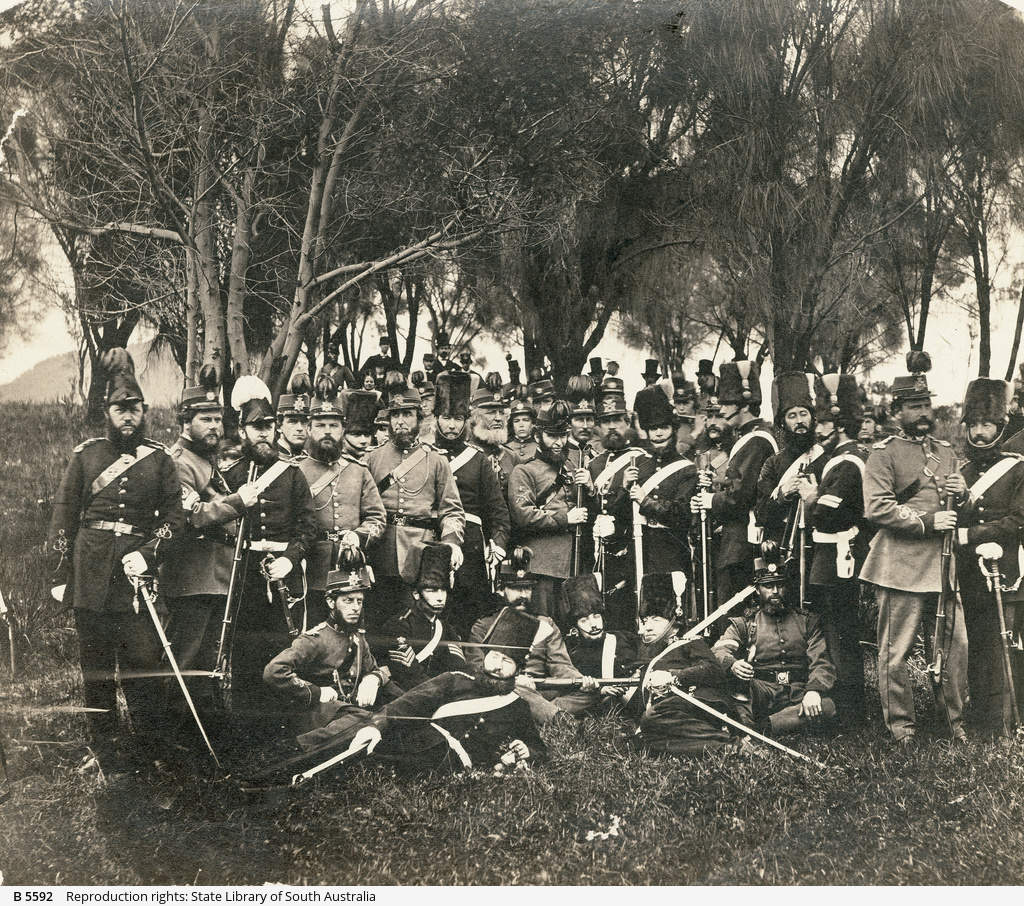
Thomas JONES was part of the Adelaide Marksmen/Rifle club and the German Rifle Club and had been part of a committee trying to establish a mounted rifle force. He continued his interest when he moved to Kapunda. There was a strong movement at the time for volunteer militia and mounted riflemen in the colony. The Kapunda Rifles were issued with their first uniforms in 1860. They had “grey Sydney tweed trousers, with red stripe, also a blue coat with red facings, and cap bearing the initials K. V.”

South Australian Volunteer Forces 1860
State Library of South Australia [B 5592]

The Northern Brigade was formed, made up of the small rifle brigades in the region. They would meet for shooting competitions sometimes at nearby Bakers Flat, and would often have functions at the Sir John Franklin. Thomas Rowlands Jones was still considered one of the best shots in the colony, and won rifles and money in competitions. He acted as scrutineer at some competitions, inspecting the targets to determine a winner.

In July of 1860 at the Sir John Franklin, a meeting took place to form the Northern volunteer corps, bringing several volunteer brigades together. The volunteers began drilling in preparation for the opening of the new railway in Kapunda. Unfortunately, the Angus Park group were not going as well as others. Some of the Angus Park “Germans were so insubordinate and careless” that Captain Connor had to take their arms and uniforms and give them to Greenock who were showing great zeal.

Railway to Kapunda


With the construction of the railway in 1860, it seemed as though the town’s prospects were starting to improve. A new post office and telegraph office were constructed and many other businesses started to spring up.

In June 1860 a group of about half a dozen members of parliament were invited by the Commissioner of Public Works to inspect the progress of the train line to Kapunda. The day before the outing it was found that numbers had bumped up to 20, arrangements for dinner at the Sir John Franklin hotel had to be promptly changed. On the morning of the outing at the Gawler train station it was found that around 30 members of parliament from both houses had arrived with their friends and officials, so a telegram to the Sir John Franklin had to be quickly sent to arrange dinner for 40.

On the journey, they inspected the line, bridges, cuttings, causeways and stations under construction. Some of the passengers on the outing had very little experience of train travel. The curves and cuttings through the hills as they approached the river Light were a cause of apprehension for many of them. The bridge over the river Light was not yet completed so the passengers had to disembark at that point. The party began to break up and it was a smaller group of ministers and officials that were left to inspect the progress at the Kapunda station. Once it was time for dinner the Kapunda locals were excited to see so many politicians in town so “several Kapunda gentlemen, about 50 in all” joined the party for a “substantial dinner”. “The tables were loaded with the good things of this life.”[i] Having worked in the hospitality industry I think it is amazing that Thomas and Theophila were able to throw together such a large impromptu dinner. The party drank to the health of Her Magesty and His Excellency and enjoyed lively songs during their meal. On the party’s return journey home they were joined by several hundred of the workmen that had been working on the line, also heading home for the weekend.

“Happy in the prospect of revisiting their hearthstones after a week’s labor upon one of the most simply grand and useful productions of modern ingenuity and skill.”[ii]

On the 10th of August 1860 a group of about 35 people were invited to inspect the soon to open line between Gawler and Kapunda. The group arrived by special train and were treated to a meal and entertainment at the Sir John Franklin Hotel. It was reported that:

“ the company, whose appetites were whetted by the long trip and the bracing air of a delightful day, did ample justice to Host Jones's liberal catering and exquisite cuisine.”


On Monday the 13th of August 1860 the Northern Extension line to Kapunda was finally officially opened. A train left Adelaide with 13 carriages with around 600 passengers for the event. The line was opened by the Governor and there were many parliamentarians along for the event.

“A very large proportion of the passengers were ladies, and we venture to say that never before has Kapunda been the receptacle of such a galaxy of beauty and fashion.”[iii]

The train left Adelaide at 10:30am with cheers from the large crowd of spectators that had gathered. All of the stations along the line were decorated with evergreens, flowers and flags and crowds gathered to wave and cheer at the train.

They picked up another 52 passengers at Gawler and attached another engine. The group were uneasy with the twists and turns before the river Light, but were amazed at the marvels of modern engineering. They stopped at the Bridge over the River Light to inspect its construction and then went on to arrive at Kapunda at 1:17pm. 

Kapunda Railway Station Approx 1907
State Library of South Australia [B 11985]


The lovely Kapunda Station was built using locally mined bluestone. It was also decorated with evergreens and flags for the occasion. His Excellency Sir Richard G MacDonnell Governor in Chief of Her Majesty’s Provence of South Australia was greeted by the Reverend Mr Oldham, and the Captains of the Angaston and Kapunda Rifles. The Kapunda Rifle Corp were there with about 50 members and accompanied by their band. They formed a guard of honour. After some speeches, the Governor proceeded to a crane which he himself used, to symbolically load the first bale of wool and the first bag of copper ingots onto the train. The vice-regal party then were taken by carriage to the Sir John Franklin hotel amid a salute fired by the Kapunda Blacksmiths’ Artillery Company. The main street was decorated with flags, mottos, and garlands of evergreen. At the Sir John Franklin the Governor received visitors until it was time to leave for a great banquet at Crase’s rooms at the North Kapunda Hotel (a rival hotel to the Sir John Franklin). There they had many speeches and toasts. The return train to Adelaide left at 5:30pm, but had to go back when they realised they had left the vice-regal party behind, in all it was only a 5 minute delay and the train arrived safely back in Adelaide at around 8pm.

Also...

Also in August of 1860 William Hislop an employee of Thomas JONES at the Sir John Franklin, was given two 1£ notes to get change. William took his chances, ran off with the money and did not return. Perhaps he used the new train as a getaway? He was caught by police in Adelaide and sentenced to three months gaol.

In December 1860 a large crowd at the Sir John Franklin hotel enjoyed the entertainment of Mr Henry Julian Hall, polyphonist. I have found an advertisement from a show he did in New Zealand which is handy as a description for what the show may have been like.


1862, Page 1 Advertisements Column 6
Daily Southern Cross, Volume XVIII, Issue 1531, 19 June 1862, Page 1,
 
http://paperspast.natlib.govt.nz/cgi-bin/paperspast?a=d&d=DSC18620619.2.2.6


Expanding Family

On the 2nd of August 1861 Thomas and Theophila welcomed the arrival of their son Horace Foley JONES, born in Kapunda.


Next Time


Next blog post will be about a downturn in fortune for the Jones' Sir John Franklin Hotel in Kapunda, Explorer mania, and a new business venture.


1860 'Classified Advertising', The South Australian Advertiser (Adelaide, SA : 1858 - 1889), 27 June, p. 1. , viewed 18 Jun 2016, http://nla.gov.au/nla.news-article1206502
1860 'KAPUNDA.', South Australian Weekly Chronicle (Adelaide, SA : 1858 - 1867), 19 May, p. 1. (Supplement to the South Australian Weekly Chronicle.), viewed 28 Mar 2016, http://nla.gov.au/nla.news-article90251543
1860 'BENCH OF MAGISTRATES.', South Australian Register (Adelaide, SA : 1839 - 1900), 16 March, p. 2. , viewed 19 Jun 2016, http://nla.gov.au/nla.news-article49896527
1859 'BENCH OF MAGISTRATES.', Adelaide Observer (SA : 1843 - 1904), 17 September, p. 3. , viewed 27 Mar 2016, http://nla.gov.au/nla.news-article158129706
1849 'NEW GENERAL PUBLICANS' LICENCES.', South Australian Register (Adelaide, SA : 1839 - 1900), 12 September, p. 4. , viewed 18 Jun 2016, http://nla.gov.au/nla.news-article50247760
1849 'LAW AND POLICE COURTS. BENCH OF MAGISTRATES.', Adelaide Times (SA : 1848 - 1858), 13 December, p. 3. , viewed 18 Jun 2016, http://nla.gov.au/nla.news-article206981635
1849 'BENCH OF MAGISTRATES.', South Australian Gazette and Mining Journal (Adelaide, SA : 1847 - 1852), 14 June, p. 4. , viewed 18 Jun 2016, http://nla.gov.au/nla.news-article195937869
Wikipedia contributors, 'Kapunda', Wikipedia, The Free Encyclopedia, 27 April 2016, 11:02 UTC, <https://en.wikipedia.org/w/index.php?title=Kapunda&oldid=717386196> [accessed 17 June 2016]
1860 'KAPUNDA.', The South Australian Advertiser (Adelaide, SA : 1858 - 1889), 21 May, p. 3. , viewed 08 Jul 2016, http://nla.gov.au/nla.news-article1205447
1860 'KAPUNDA.', South Australian Register (Adelaide, SA : 1839 - 1900), 14 April, p. 3. , viewed 18 Jun 2016, http://nla.gov.au/nla.news-article49889180
1860 'KAPUNDA.', South Australian Register (Adelaide, SA : 1839 - 1900), 29 August, p. 3. , viewed 10 Jul 2016, http://nla.gov.au/nla.news-article50025446
1862 'KAPUNDA.', South Australian Register (Adelaide, SA : 1839 - 1900), 27 March, p. 3. , viewed 10 Jul 2016, http://nla.gov.au/nla.news-article40468355
1861 'THE KAPUNDA AGRICULTURAL AND HORTICULTURAL SOCIETY'S ANNUAL EXHIBITION.', Adelaide Observer (SA : 1843 - 1904), 2 March, p. 2. (Supplement to the Adelaide Observer.), viewed 10 Jul 2016, http://nla.gov.au/nla.news-article158179484
1861 'KAPUNDA AGRICULTURAL AND HORTICULTURAL SOCIETY'S ANNUAL EXHIBITION.', South Australian Register (Adelaide, SA : 1839 - 1900), 28 February, p. 3. , viewed 10 Jul 2016, http://nla.gov.au/nla.news-article50018869
1860 'KAPUNDA.', South Australian Weekly Chronicle (Adelaide, SA : 1858 - 1867), 12 May, p. 2. , viewed 11 Jul 2016, http://nla.gov.au/nla.news-article90251807
1861 'THE VOLUNTEER MOVEMENT.',South Australian Register (Adelaide, SA : 1839 - 1900), 26 March, p. 5. , viewed 19 Jun 2016, http://nla.gov.au/nla.news-article50021708
1866 'KAPUNDA.', South Australian Register (Adelaide, SA : 1839 - 1900), 30 July, p. 3. , viewed 18 Jun 2016, http://nla.gov.au/nla.news-
1860 'INSPECTION OF THE NORTHERN EXTENSION RAILWAY.', The South Australian Advertiser (Adelaide, SA : 1858 - 1889), 21 June, p. 3. , viewed 08 Jul 2016, http://nla.gov.au/nla.news-article1206326
1860 'THE RAILWAY TO KAPUNDA',Adelaide Observer (SA : 1843 - 1904), 23 June, p. 7. , viewed 08 Jul 2016, http://nla.gov.au/nla.news-article158175712
1860 'KAPUNDA.', South Australian Register (Adelaide, SA : 1839 - 1900), 10 August, p. 3. , viewed 18 Jun 2016, http://nla.gov.au/nla.news-article50026032article41019946
1860 'INSPECTION OF THE NORTHERN LINE BETWEEN GAWLER AND KAPUNDA.', South Australian Register (Adelaide, SA : 1839 - 1900), 11 August, p. 2. , viewed 19 Jun 2016, http://nla.gov.au/nla.news-article50024439
1860 'OPENING OF THE KAPUNDA RAILWAY.', South Australian Weekly Chronicle (Adelaide, SA : 1858 - 1867), 18 August, p. 5. , viewed 11 Jul 2016, http://nla.gov.au/nla.news-article90250769
1860 'OPENING OF THE RAILWAY FROM GAWLER TO KAPUNDA.', Adelaide Observer (SA : 1843 - 1904), 18 August, p. 3. , viewed 11 Jul 2016, http://nla.gov.au/nla.news-article158176484
1860 'OPENING OF THE RAILWAY FROM GAWLER TO KAPUNDA.', South Australian Register (Adelaide, SA : 1839 - 1900), 14 August, p. 2. , viewed 11 Jul 2016, http://nla.gov.au/nla.news-article50025627
1860 'LOCAL COURTS.', South Australian Register (Adelaide, SA : 1839 - 1900), 28 August, p. 3. , viewed 18 Jun 2016, http://nla.gov.au/nla.news-article50023301
1860 'OPENING OF THE KAPUNDA RAILWAY.', The South Australian Advertiser (Adelaide, SA : 1858 - 1889), 14 August, p. 3. , viewed 08 Jul 2016, http://nla.gov.au/nla.news-article822747
Birth Index South Australia, Horace Foley Jones.

[i] 1860 'THE RAILWAY TO KAPUNDA',Adelaide Observer (SA : 1843 - 1904), 23 June, p. 7. , viewed 08 Jul 2016, http://nla.gov.au/nla.news-article158175712
[ii] 1860 'INSPECTION OF THE NORTHERN EXTENSION RAILWAY.', The South Australian Advertiser (Adelaide, SA : 1858 - 1889), 21 June, p. 3. , viewed 08 Jul 2016, http://nla.gov.au/nla.news-article1206326
[iii] 1860 'OPENING OF THE KAPUNDA RAILWAY.', South Australian Weekly Chronicle (Adelaide, SA : 1858 - 1867), 18 August, p. 5. , viewed 11 Jul 2016, http://nla.gov.au/nla.news-article90250769

Sunday, 24 April 2016

The Jones family part IV: Music, Ice and Pineapples at the Blenheim Hotel


Blenheim Hotel, Adelaide, S.A. Hindley St., 1851.[i]
Borrow Collection, Flinders University Library.
Thank you to Jenny and Kylie for their assistance.


I mentioned in the previous post, that in 1855 Thomas and Theophila Jones had a baby girl. At the time I did not know the baby’s name, but luckily my 4th cousin Nick Haines contacted me with information transcribed from the Jones Family Bible. The baby’s name was Florence Edith JONES[i]. Thanks Nick!

The couple had three more children whilst living in Adelaide. Robert James JONES was born 14 Dec 1856 but sadly died when only two months old[ii]. On the 17th Jan 1858 they had a daughter Emily Agnes JONES, then on the 2 Aug 1859 they had another daughter Caroline Rowlands JONES. So by 1859 they had five surviving children, 4 daughters and one son, and had lost two little sons.[iii]

Under the patronage of Thomas, the Blenheim Hotel became well known for its musical evenings on Tuesdays, Thursdays, and Saturdays. They ran a series of weekly excursions to Glenelg and opened billiard rooms. The Blenheim became well known for its lavish functions, wine, and cold drinks.


Ice! Domestic News, Adelaide Times 1856.[iv] 

Ice!

In 1856 the Blenheim began serving chilled and iced drinks. It was even mentioned in a Tasmanian newspaper that T.R. Jones at the Blenheim was serving ice. This made me wonder, how did anyone in South Australia get ice in 1856?

Ice, The Adelaide TImes  [xi]

Most ice in Australia in the 1850’s came from ice harvesting in the U.S.A. The ice was shipped in from Wenham Lake in Massachusetts, [v]., which was at least an 115-day journey by steamship. At Wenham lake, there was a large ice farm where the ice was cut into slabs and shipped all around the world. Wenham “Crystal ice” claimed to have special properties that kept it frozen for longer than other ice and marketed as being very pure and clean. Wenham ice was popular in England, but the need for ice in India and Australia was great. There were huge difficulties in shipping ice half way around the world, the length of the journey, temperatures crossing the equator, and the salt air would all melt the ice.[vi] This made shipping ice to Australia very expensive, and so was quite a luxury. Plant Ice began to be competitive by around 1858[vii] when Melbourne manufacturers The Patent Ice Company began exporting to other Australian colonies, and soon manufactured ice began to dominate the Australian market.

Wenham Ice Harvest.
Thanks to "Welcome to Wenham" http://wenham.essexcountyma.net/[viii]

Disney's Frozen has a musical scene dedicated to Ice Harvesting.


In 1857, the Blenheim really ramped up the luxury by offering not only ice but punch containing pineapple! They also on-sold ice to families and businesses.

Pine Apples,Adelaide Times (SA : 1848 - 1858)  [ix] 

I tried to find a recipe for Rhine Wine Punch, and I could find a few variations. It could have been based on the traditional German May Wine punch flavoured with Woodruff, but there are a number of Rhine wine punch recipes containing wine, brandy, tea, and fruit.

Classic Mixology has a May wine Punch
http://classicmixology.com/punches/may_wine_punch/1888
The Flowing Bowl, published in 1892 has a Rhine Wine Punch recipe on pg. 233. The Flowing Bowl

Glenelg

In 1857 Thomas Jones began running catered day trips to Glenelg via paddle steamer, complete with musical entertainment.

LOCAL INTELLIGENCE.
The Excursion Trip to GLENELG We see by advertisement that Mr Jones, of the Blenheim , Hotel, has announced his first of a series of weekly excursion trips, to start on Sunday morning for the Bay. The route selected offers the greatest variety of objects of interest within the range of a day's excursion from the city, and the fares are so moderate, that no possible objection can be raised on that score. This trip will not only offer the advantage of novelty, but will be a decided improvement on any attempts hitherto made in this colony to cater for outdoor amusement. We may add that a first rate band has been engaged to give additional animation to the proceedings.[x]

Glenelg advertisement[v]
Sketch of the old Glenelg Pier with the Pier Hotel in the background c.1870. 
State Library of South Australia SLSA PRG280/1/44/508


Music

As well as the musical evenings held at the Blenheim in 1858 Thomas played what I think might have been a  Xylophone at the Victoria Theatre to a large crowd.  
“A solo performance by Mr. Jones, of the Blenheim Hotel upon the yElophone, was deservedly encored, but the instrument is scarcely adapted for so large a building.”[xii]

Billiards

The Blenheim Hotel had a Billiard room attached at the back it was large and well lit for the times and held competitive matches. 
There was a fire in the Billiard room at 10pm 24th Feb 1856. It had started in the chimney of the adjoining kitchen, and had spread to the skirtings and walls of the Billiard room. It was discovered early and with community effort, a good water supply and the assistance of two fire engines (the Cornwall and the “small but useful” engine of Mr. Nitchke) the fire was put out without too much damage.[xiii] 
By 1858 Thomas was advertising that he had the “Best billiard room in the Colony.”[xiv]
“SPORTING.-We are informed that a billiard match, for £50 a-side, will be played in Mr. Jones's billiard-room, attached to the Blenheim Hotel, between Mr. A. Lazar and a "crack'' player expected from Melbourne by the Havilah, immediately after the arrival of which vessel the match is to come off. The money has been posted on both sides, and the match will no doubt be one of unusual interest, and prove an exhibition of superior play not often to be seen. We understand that Mr. Jones has just purchased an excellent billiard-table, which will add to the attractions of his already very attractive room, and afford the means of accommodating even a larger number of visitors than at present attend his tables.”[xv]

For my next blog post I will have more on the Jones Family.


[i] Thomas Rowlands Jones Family Bible. Transcribed by Nick Haines in 1980s.
[ii] 1856 'Family Notices', South Australian Register (Adelaide, SA : 1839 - 1900), 15 December, p. 2. , viewed 27 Feb 2016, http://nla.gov.au/nla.news-article49759345
[iii] South Australian Birth Registration transcription. Genealogy SA.
[iv] 1856 'DOMESTIC NEWS.', Adelaide Times (SA : 1848 - 1858), 16 February, p. 2. , viewed 24 Apr 2016, http://nla.gov.au/nla.news-article207089431
[v] Ice trade. (2016, April 22). In Wikipedia, The Free Encyclopedia. Retrieved 07:37, April 24, 2016, from https://en.wikipedia.org/w/index.php?title=Ice_trade&oldid=716491730
[vi] http://www.iceharvestingusa.com/crystalblocks1.html
[vii] Nigel Isaacs, Sydney's first ice, Dictionary of Sydney, 2011, http://dictionaryofsydney.org/entry/sydneys_first_ice, viewed 24 April 2016
[viii] "Welcome to Wenham" http://wenham.essexcountyma.net/
[ix] 1857 'LOCAL INTELLIGENCE.', Adelaide Times (SA : 1848 - 1858), 25 February, p. 2. , viewed 24 Apr 2016, http://nla.gov.au/nla.news-article207173378
[x] 1857 'LOCAL INTELLIGENCE.', Adelaide Times (SA : 1848 - 1858), 19 December, p. 2. , viewed 23 Apr 2016, http://nla.gov.au/nla.news-article207126256
[xi] 1857, Adelaide Times (SA : 1848 - 1858), 19 December, p. 1. , viewed 23 Apr 2016, http://nla.gov.au/nla.news-page22713284
[xii] 1858 'No title', The South Australian Advertiser (Adelaide, SA : 1858 - 1889), 13 August, p. 3. , viewed 24 Apr 2016, http://nla.gov.au/nla.news-article782230
[xiii] 1856 'IMMIGRATION BOARD.', South Australian Register (Adelaide, SA : 1839 - 1900), 25 February, p. 3. , viewed 24 Apr 2016, http://nla.gov.au/nla.news-article49751727
[xiv] 1858 'Classified Advertising', The South Australian Advertiser (Adelaide, SA : 1858 - 1889), 9 September, p. 4. , viewed 24 Apr 2016, http://nla.gov.au/nla.news-article783138
[xv] 1859 'The Advertiser.', The South Australian Advertiser (Adelaide, SA : 1858 - 1889), 20 December, p. 2. , viewed 24 Apr 2016, http://nla.gov.au/nla.news-article1200382


Thursday, 7 April 2016

The Jones Family Part III: The Blenheim, electioneering and riots.


In my last post I finished with Thomas Rowlands Jones’ advertisement for the Blenheim hotel and wine tasting on the London Docks.

Thomas’ wine tasting experience was put to good use in his new hotel.

"Colonial Wine-We have now before us a sample of some colonial wines, about to be introduced to public notice by Mr Jones, of the Blenheim Hotel. There are two samples, one of Tokay and the other Red Muscat. For soundness and delicacy of flavour we can recommend them especially to the notice of families, as an agreeable and cheap substitute for imported wines generally used."[i]

            [ii]

On the home front Theophila's recently remarried mother Rosalia Shroeder died on the 29th of April 1854 in Adelaide. She was only 40 years old. On the 12th of August 1855 in the Blenheim hotel Adelaide, Thomas and Theophila had a baby girl. Her birth was advertised in the newspaper[iii] but I cannot find an official birth registration for her. I do not know her name or if she survived past infancy.

Blenheim hotel held Billiard matches, musical evenings as well as, Adelaide city council meetings, Masonic lodge meetings, coroner’s inquests, voting and electioneering, and many other community meetings and events.

This is a photo of Hindley street around 1870. The Blenheim Hotel is the one on the corner with the cart out the front. State Library of South Australia [B 1934]


ON the 19th September 1855 at about 12 o’clock in the afternoon, gunfire rang out from the balcony of the Blenheim Hotel. Members of the public had begun to assemble outside the hotel to listen to the candidates for West Adelaide in the Legislative Council, Mr. James Hurtle Fisher and Mr. Anthony Forster speak . The crowd had begun forming early in the morning and by the time it was 12 o’Clock the group was large stretching in both directions of Hindley street. The Mayor acting as Returning officer spoke at 1 o’clock, and then it took 45 minutes for the candidates to argue over who was going to speak first[iv]. I imagine this would have made the crowd quite impatient.

The Legislative Council was originally appointed by the Governor of South Australia on behalf of the Crown, and was reformed in 1851 to include 16 elected representatives, and eight appointed by the Governor, making a total of 24 members. Voting for the elected representatives was restricted to land-owning men only.

Over the next five hours the two candidates and a few of their supporters addressed the crowd. For many the primary difference between the two candidates was how each proposed that a new Constitution and system of governing should be drawn up.


Anthony Forster. State Library of South Australia [B 53194]
Mr. Anthony Forster was the editor and part owner of the South Australian Register newspaper. Forster supported a model of Legislative Council that was fully elected with universal suffrage which meant common men being able to vote along with male landowners. He also supported elections being held by confidential ballot, and for responsible government with an upper and lower house. He was against public money going towards churches as annual grants.


Sir James Hurtle Fisher. State Library of South Australia [B 6978]

Mr. Fisher was a barrister-at-law and the former resident commissioner of the colony of South Australia, arriving in 1836. He was the first Mayor of Adelaide, and was elected as a member of the Legislative council in 1853[v]. He believed in a single chamber and for it to remain as 16 elected members along with Governor appointees. He also held the strong belief that the Legislative Council and Governor should gain control of the Land Fund. He was against universal suffrage. Mr. Fisher wanted to postpone building of railways, including one to Gawler, instead focusing on the need for water supplies in Adelaide. There was also some controversy over “Victoria Square” which was an area he was engaged in professionally, to make a land allowance for a “dominant” Anglican church he was a member of. He was also for the continuation of annual grants to churches.

During the speeches the crowd was quite unsettled.
 “It was as if all the flibbartigibbits in Adelaide had assembled.”[vi]
Some of the crowd carried cudgels and several fights broke out. More than one person had their heads bloodied by blows. A large group of “Irishmen” (the implication being that they were working class and unable to vote) broke into a “war dance” yelling and waving their shillelaghs (a type of cudgel) in the air. Captain Fewson demanded them to be quiet, yelling at them “Lie down you blaguards!” and “Attention rascals!”.[vii] At one stage members of the crowd began throwing brick-bats (stones and bits of broken bricks) up at the balcony and at the voters. People rushed into the Hotel trying to get away from the missiles, knocking over tables in their rush. Windows were smashed and more than one person was struck by the stones. Fights broke out in the crowd and people were beaten with cudgels.

“One ruffian struck a man on the head with a loaded whip, but he was himself soon disarmed, and received such a blow from a fist as sent him slinking off quite satisfied with his share of the disturbance.”[viii]

Some of the injured were innocent spectators. The skirmish lasted a few minutes and the police under instruction of Inspector Reid did not interfere. Several more minor skirmishes broke out during the speeches.

When the candidates had concluded their speeches, the Returning Officer asked for a show of hands, which seemed to be in favour of Mr Forster. Mr Fisher of course demanded a poll which was declared to take place there at the Blenheim hotel between 9am and 4 pm the following day.

Hindley Street Looking West. c. 1846. George French Angus.  State Library of South Australia [B 15276/41]


BALLOT DAY


After the trouble that had occurred the day before, Police were expecting the worst. They were ready with the metropolitan force and the mounted force. Extra police were sworn in the night before.

On Ballot day, the 20th September 1855, a large crowd had assembled outside of the Blenheim hotel, stretching well down the street. Polling was out in the open under the balcony of the Blenheim (perhaps because of the overturned tables the day before?) and the crowd was easily able to see who each man was voting for by the coloured card in their hand. I am sure the crowd would have been quite vocal in their approval or disapproval.

For most of the morning things had proceeded quite peacefully apart from the stirring up of dust on the unmade street by the large number of spectators. Before long though some voters had begun reporting to police that they had been assaulted on the way to the polling station and were unable to cast their vote.

By ballot closing time at 4 o’clock it began to be apparent that Mr. Forster had a significant lead and supporters of Mr. Fisher felt that his voters had not been given fair access to give their vote due to the crowd.

A large group of drunk and disgruntled Irishmen became enraged outside. A dozen or two of them stormed into the Blenheim and forced their way upstairs and onto the balcony. Once on the balcony they tore down the flags. They broke the flagpoles up to make staves. They then rejoined the main group then numbering over one hundred, all armed with cudgels and other weapons like fire pokers. The mob then pushed the crowd down the street causing chaos and attacking anyone wearing the colours of Mr Forster.

The Exchange Hotel c. 1865. State Library of South Australia [B 3645] 


They arrived at the Exchange hotel, (also in Hindley Street) where Mr Forster's campaign had been run from. There they tried to climb onto the balcony to tear down the flags, but people on the balcony forced them down. Stones and brick-bats were then pitched at the Exchange balcony forcing people inside and smashing windows. Forster’s supporters rushed outside the hotel began to fight back Fisher’s supporters.
“Sticks and heads were meeting in the street in all directions”[ix]
Some of Fisher’s supporters then managed to climb onto the balcony and tore down the flags and again used the flagpoles as weapons. They then threw stones down at the crowd below hitting both their supporters and opponents. The mounted police at that point galloped in with the metropolitan foot police lead by Superintendent Tolmer closing in from the other side to tackle the riot. The rioters had then forced their way into the Exchange hotel and had locked the doors from within. Superintendent Tolmer attempted to climb up onto the balcony. A rioter grabbed his leg to drag him down but he managed to free himself by kicking the man in the face with the heel of his heavy spurred boot. Other police joined him on the balcony and soon the rioters were overpowered and many of the worst of them were arrested. As the riot act was apparently read at the Blenheim hotel (the only time in Adelaide’s history) it is possible that some arrested were given life in prison. [x]

Although Anthony Forster won the ballot, Mr Fisher of course contested that it was not run fairly. It was not until the following year that Mr. Forster was seated on the Legislative council. It is not surprising that after the riot 15 out of the 16 Legislative Council members voted for the secret ballot and it was used for the next election in 1857. James Hurtle Fisher became Speaker of the house in 1855 -1856 and President of the House in 1857 - 1865.

In 1856 the Council began drafting the Constitution and by 1857 the new parliament of South Australia was formed.

Amongst all of these history making events I wonder what Thomas, Theophila , my four year old great great grandmother Elizabeth, little toddler Henry and the new baby were doing. I imagine Thomas was probably in his hotel when it was dramatically stormed. I wonder if Theophila and the children sensing trouble brewing had kept away on the speech and polling days.

In 1856 Thomas Jones went to court suing the Returning officer for damages incurred on the polling day the amount of £30. To my disappointment Thomas did not make a lot of money at the bar in the hotel that day. The court found in his favour and at first for the full amount of £30 but the “Act” only allowed the sum of £20 to the returning officer, so judgment was given for that amount.[xi]

Years later in 1900 when the Blenheim hotel was demolished the South Australian Register Newspaper reported on the historical significance of the hotel . A new hotel was built in its place.

If you would like to read more on the Riot at the Blenheim, you can read the news accounts on TROVE listed below in my references, or you can read articles at History SA. I have based my retelling on news reports, but the History SA articles helped me to get my head around what went on. If I have made any mistakes or if I have misunderstood the meaning of any events please let me know.

Corinne Ball, Migration Museum, ‘Hindley Street riot’, Adelaidia, History SA, http://adelaidia.sa.gov.au/events/hindley-street-riot, accessed 6 April 2016.

Corinne Ball, Migration Museum, ‘Hindley Street riot’, SA History Hub, History SA, http://sahistoryhub.com.au/events/hindley-street-riot , accessed 6 April 2016.


More on the Jones Family next time


[i] 1855 'DOMESTIC NEWS.', Adelaide Times (SA : 1848 - 1858), 22 November, p. 2. , viewed 29 Mar 2016, http://nla.gov.au/nla.news-article207075590

[ii] 1855 'Advertising', Adelaide Times (SA : 1848 - 1858), 11 December, p. 1. , viewed 07 Apr 2016, http://nla.gov.au/nla.news-article207076233

[iii] 1855 'Family Notices', South Australian Register (Adelaide, SA : 1839 - 1900), 13 August, p. 2. , viewed 27 Feb 2016, http://nla.gov.au/nla.news-article49300221

[iv] 1900 'AN HISTORIC BUILDING DEMOLISHED.', South Australian Register (Adelaide, SA : 1839 - 1900), 20 July, p. 3. , viewed 27 Feb 2016, http://nla.gov.au/nla.news-article54454310

[v] 'Fisher, Sir James Hurtle (1790–1875)', Australian Dictionary of Biography, National Centre of Biography, Australian National University, http://adb.anu.edu.au/biography/fisher-sir-james-hurtle-2045/text2531, published first in hardcopy 1966, accessed online 7 April 2016.

[vi] 1855 'WEST ADELAIDE.', South Australian Register (Adelaide, SA : 1839 - 1900), 20 September, p. 3. , viewed 4 April 2016, http://nla.gov.au/nla.news-article49298579

[vii] 1855 ‘NOMINATIONS’, Adelaide Times (SA: 1848 - 1858), 20 September, p.2. , viewed 4 April 2016. http://nla.gov.au/nla.news-article207073569

[viii] 1855 'WEST ADELAIDE.', Adelaide Observer (SA : 1843 - 1904), 22 September, p. 8. , viewed 07 Apr 2016, http://nla.gov.au/nla.news-article158105660

[ix] 1900 'AN HISTORIC BUILDING DEMOLISHED.', South Australian Register (Adelaide, SA : 1839 - 1900), 20 July, p. 3. , viewed 27 Feb 2016, http://nla.gov.au/nla.news-article54454310

[x] 1911 'THE RIOT ACT.', The Advertiser (Adelaide, SA : 1889 - 1931), 17 October, p. 9. , viewed 31 Mar 2016, http://nla.gov.au/nla.news-article5325128

[xi] 1856 'LAW AND CRIMINAL COURTS.', South Australian Register (Adelaide, SA : 1839 - 1900), 7 March, p. 3. , viewed 03 Apr 2016, http://nla.gov.au/nla.news-article49747610